 how-to
How Do You Prepare for a Domestic Violence Restraining Order Cross-Examination?
Last Updated: November 3, 2026
Quick Summary
Preparing for a DVRO cross-examination means keeping your answers short, answering only the question asked, and staying consistent with your affidavit. Write out a timeline of key events with dates and details, and pause before answering so you never guess on the stand.
- On cross, "I don't know" and "I don't recall" are valid answers; never guess.
- Write down key events in order with dates, times, and who was there.
- Object before the witness answers, or the objection may be treated as waived.
- Say only "Objection," name the ground, and stop without explaining.
- Keep a log of every filing with date, document, request, and ruling.
Table of Contents
- What Happens at a DVRO Hearing Cross-Examination
- How to Testify at a Restraining Order Hearing
- DVRO Hearing Cross-Examination Tips That Protect Your Credibility
- Common Objections in Domestic Violence Hearings and How to Raise Them
- Examples of Bad vs. Good Cross-Examination Questions
- Handling Litigation Abuse and Remote Hearing Etiquette
- Request a Free Case Evaluation Before Your Court Date
- Frequently Asked Questions
What Happens at a DVRO Hearing Cross-Examination
A domestic violence restraining order hearing is a civil court proceeding where a judge decides whether to grant a protective order.
Here is the short version of what happens.
The petitioner asks for the order. The respondent answers the allegations. Each side can call witnesses and present evidence.
The courtroom is formal, but the judge usually runs the hearing like a focused conversation. You will be sworn in.
Direct Examination vs. Cross-Examination
Direct examination is when your own attorney asks you questions. The goal is simple: tell your story in a clear order.
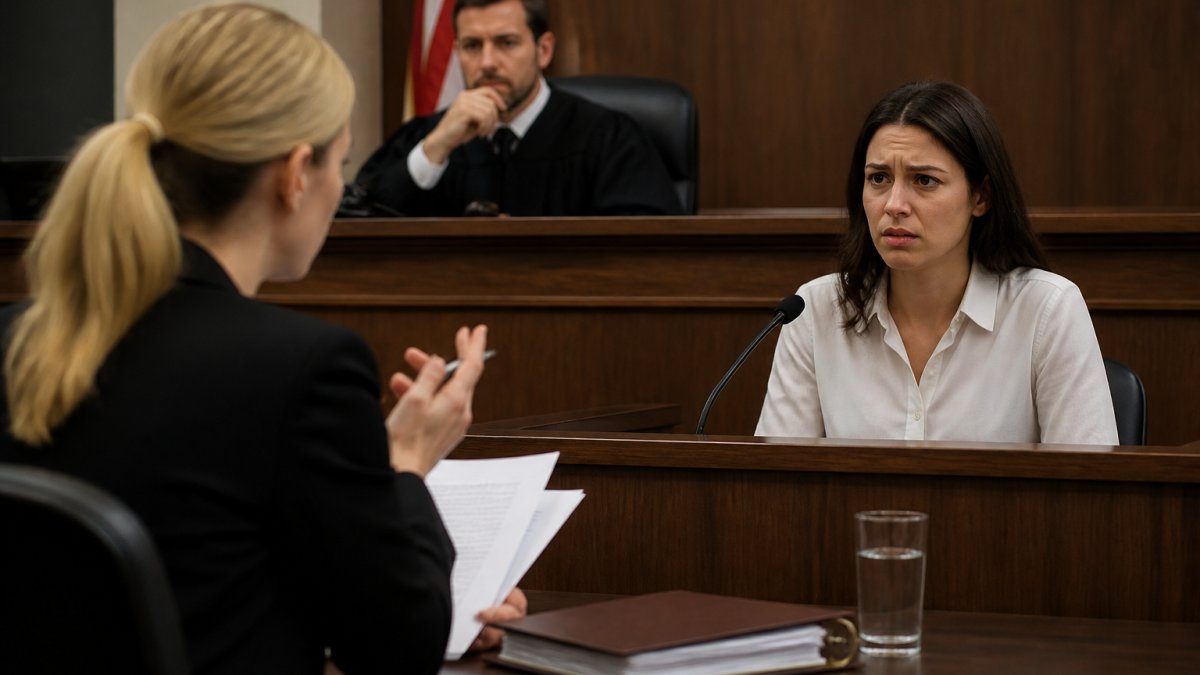
Cross-examination is when the other side questions you. The goal shifts. The other attorney wants to test your memory, poke holes in your account, and raise doubts about your credibility.
The rules differ too:
- On direct, you can explain. You can give context.
- On cross, you answer only the question asked. Short answers work best.
- On cross, you never guess. "I don't know" and "I don't recall" are valid answers.
This is where most self-represented parties get into trouble. They treat cross like a debate. It is not.
How to Testify at a Restraining Order Hearing
Testimony at a restraining order hearing should be short, specific, and tied to dates.
Start with a timeline. Write down the key events in order: dates, times, what was said, who was there.
Then follow these steps:
- Swear in and stay calm. Take a breath before your first answer.
- Answer the question asked. Nothing more.
- Pause before answering. A one-second pause stops you from rushing.
- Use dates and details. "On March 3, he called me four times after 10 p.m." beats "He kept calling."
- Correct mistakes right away. If you misspeak, say so on the spot.
- Stay polite. Never argue with the attorney or the judge.
Watch out: guessing at a date or detail on the stand can undercut your whole account.
For a deeper walkthrough of the questioning process, see our guide on how to prepare for cross-examination.
DVRO Hearing Cross-Examination Tips That Protect Your Credibility
Credibility is the whole ballgame in a DVRO cross-examination. The judge is deciding who to believe.

A common mistake is trying to win every point. You do not need to. You need to stay consistent.
Here is how we coach clients:
- Keep answers short. "Yes," "No," and "Correct" are complete answers.
- Do not volunteer information. Extra words give the other side new angles.
- Stay consistent with your affidavit. Your written statement and your testimony must match.
- Do not get defensive. A calm tone reads as honesty.
The other attorney may try to bait you into anger. Do not take it. Judges notice who stays composed.
Preparing Your Testimony and Exhibits
Your exhibits do the quiet work for you. Texts, photos, medical records, and police reports all carry weight when they are organized.
Label each exhibit. Know which one supports which fact. Practice saying the exhibit number out loud so you can point to it fast when asked.
If your order is civil rather than criminal, the rules and stakes differ. Our breakdown of civil vs. criminal restraining orders explains which applies to your case.
Common Objections in Domestic Violence Hearings and How to Raise Them
Objections are the only tool a self-represented party has to stop an improper question before it lands. The rules are unforgiving on timing: in most state family court proceedings, you must object before the witness answers. If you wait until after the answer, the judge has already heard it, and many judicial officers will treat the objection as waived. Stand or speak up the moment the question ends, not after the answer.
The Five Objections You Will Actually Use
Hearsay. A statement made outside court, offered to prove that what was said is true.
Relevance. The question has no tendency to make a fact of consequence more or less probable.
Speculation. The witness is being asked to guess.
Asked and answered. The same question, same witness, same point, repeated to wear you down.
Request a Free Case Evaluation →
Lack of foundation. No one has established the witness personally knows the answer.
The Exact Script
Say the word "Objection," name the ground, and stop. That is the whole sentence.
- "Objection, hearsay."
- "Objection, relevance."
- "Objection, speculation."
- "Objection, asked and answered."
Do not explain. Do not argue. Do not cite a rule number unless the judge asks.
Watch out: objecting to every question, sometimes called a speaking objection or a shotgun objection, reads as obstruction and can cost you credibility with the judge. For more, see our strategies for challenging witness testimony.
Objecting to Your Own Questions Being Blocked
If you are representing yourself and the other side objects to your question, do not argue back and forth. The judge will rule. If the objection is sustained, rephrase the question to remove the defect rather than repeating it. "Let me rephrase" is a complete response.
When the Other Side Objects to Your Evidence
If opposing counsel objects to an exhibit you offer, be ready to state the basis for admissibility in one sentence: who made it, when, and why it is reliable. Text messages, for example, usually need authentication, you may need to testify that you recognize the number and the conversation.
For a deeper walkthrough of the questioning process, see our guide on how to prepare for cross-examination.
Examples of Bad vs. Good Cross-Examination Questions
The questions asked on cross shape the answers. Here is the difference between a weak question and a strong one.
| Bad question | Why it fails | Better version |
|---|---|---|
| "Why did you lie about the incident?" | Argumentative, assumes the answer | "You told the police a different time, correct?" |
| "Isn't it true you're just angry?" | Asks about feelings, not facts | "You sent 14 texts that night, correct?" |
| "Tell us everything that happened." | Too open for cross | "On June 12, you were at the apartment, yes or no?" |
| "You always exaggerate, don't you?" | Uses "always," easy to deny | "You told your friend a different version, correct?" |
The pattern is clear. Good cross questions are narrow, factual, and answerable with one word. Bad ones are broad, emotional, and invite a speech.
If you are the one being cross-examined, this table works in reverse. Recognize a leading question for what it is, and answer only what it asks.
Handling Litigation Abuse and Remote Hearing Etiquette
Some parties use the court process itself as a weapon. Repeated continuances, excessive filings, motions filed the day before a hearing, and cross-examination designed to exhaust rather than to elicit facts, this pattern is often called litigation abuse. Most guides skip it entirely. Here is how to recognize it and what to do about it.
Recognizing the Pattern
Litigation abuse is not one filing; it is a pattern. Common forms in restraining order cases include:
- Continuance requests filed close to each hearing date, forcing you to re-prepare.
- Motions to quash or reconsider that recycle arguments the judge already rejected.
- Subpoenas to your employer, your therapist, or your children's school with no apparent relevance.
- Cross-examination that repeats the same question after it has been answered, or that drifts into irrelevant personal history.
- Last-minute evidence disclosures that give you no time to respond.
Building the Record
Keep a log. For every filing, record the date, what it asked for, and the outcome. A simple table, date, document, request, ruling, is enough. Bring it to the hearing. If a pattern is clear, you can tell the judge: "Your Honor, this is the third continuance request from the other side, and I have a log of each one." Judges have authority to limit filings that serve no purpose, and some courts will require a party to seek leave before filing further motions.
Objecting to Harassing Questioning
When cross-examination becomes repetitive or argumentative, you have two tools. First, object: "Objection, asked and answered" or "Objection, argumentative." Second, if the pattern continues, ask the judge for relief: "Your Honor, may I ask that counsel move to a new topic?" You are not required to endure the same question ten times.
Watch out: a judge may see frequent objections as combativeness if the questions are merely uncomfortable rather than improper. Discomfort is not the same as abuse.
Remote Cross-Examination
Many family court hearings now happen by video. The rules of evidence do not change, but the mechanics do, and the mechanics affect credibility.
- Camera at eye level. A laptop on a stack of books works. Looking down at the camera reads as evasive.
- Look at the camera when answering, not at the other party's face on screen.
- Mute when not speaking. Background noise, a dog, a television, a child, reads as disrespect and can be used to suggest you are distracted.
- Plain background, good light on your face. No bed, no kitchen clutter.
- Never read from notes off-screen. It looks like coaching, and judges notice eye movement. A single page of notes placed next to the camera is safer than a second monitor.
Treat a video hearing with the same formality as a courtroom. Judges do.
If the accusations against you are false, the stakes of cross-examination rise sharply. Our guidance on defending against false domestic violence accusations covers how to build that defense.
Request a Free Case Evaluation Before Your Court Date
Cross-examination rewards preparation and punishes improvisation. You do not get a second chance to make a first impression on the judge.
Van Nuys Crime offers personalized representation, and our team can review your case and discuss your options at a free case evaluation.
Before you hire anyone, know what to look for. Our guide on how to evaluate criminal defense lawyer experience explains what to check.
Frequently Asked Questions
What are common cross-examination questions in a domestic violence restraining order hearing?
Expect questions that test inconsistencies in your account, such as whether you called police immediately, whether you sought medical care, and whether you told anyone about the incident. Attorneys may ask about prior arguments, text messages, and your relationship history. They may also question whether you exaggerated or omitted details in your affidavit. Answer only what is asked, keep responses short, and do not volunteer information. If a question misstates something you said, correct it calmly and refer to your exhibits.
What should I avoid saying during a DVRO cross-examination?
Avoid guessing, speculating, or filling silence with extra detail. Do not argue with the opposing attorney or lose your temper, even if a question feels hostile. Never say 'I think' when you know a fact, and never claim to remember something you do not. Avoid absolute words like 'never' or 'always' unless they are true. If you do not understand a question, say so and ask for it to be repeated. Short, honest answers protect your credibility better than long explanations.
Can I object to questions during my cross-examination?
Yes, if you are self-represented you can raise objections, but you must state a legal basis such as relevance, hearsay, or asked and answered. The judicial officer decides whether to sustain or overrule. Object sparingly: constant objections without a valid basis can hurt your credibility with the court. If you have legal counsel, they will handle objections for you. Learn the basic rules of evidence before your court date so you recognize when a question crosses a line.
How does a lawyer help prepare for a restraining order cross-examination?
A lawyer can review your affidavit and exhibits, help you prepare for questioning, and explain how to answer narrowly. They also identify weaknesses in the opposing side's case, prepare objections, and handle courtroom procedure so you can focus on testifying. Request a free case evaluation to discuss your hearing.
The hearing date will arrive whether you are ready or not. Walk in with a strategy, not a hope. Get started with Van Nuys Crime and request a free case evaluation so you know exactly where you stand before you take the stand.