 how-to
Legal Rights During a Police Traffic Stop: Know Your Rights
Table of Contents
- Your Legal Rights During a Police Traffic Stop
- What to Say to Police During a Traffic Stop
- Can Police Search My Car Without a Warrant
- Passenger Rights During Traffic Stop
- Your Right to Refuse a Sobriety Test
- Common Mistakes That Undermine Your Rights
- What to Do If Your Rights Are Violated
- Conclusion
Last Updated: August 3, 2026
Your Legal Rights During a Police Traffic Stop
Understanding your legal rights during a police traffic stop is critical to protecting yourself. At Van Nuys Crime, we help individuals in the Van Nuys and San Fernando Valley area understand what officers can and cannot do during a traffic stop. The moment an officer approaches your window, the interaction can shape everything that follows, from whether charges are filed to how strong your defense becomes later.
Most people panic or comply reflexively without understanding their constitutional protections. Knowing your rights can mean the difference between walking away and facing arrest.
Below, we'll cover every critical aspect of legal rights during a police traffic stop: what to say, what to refuse, when police can search your vehicle, and what to do if your rights are violated.
Why knowing your rights matters
Most people believe they must comply with every police request during a traffic stop. That's not accurate. Police have specific legal limits, and knowing where those limits are gives you concrete power to protect yourself in the moment. According to research from the American Civil Liberties Union, traffic stops have escalated into serious charges and arrests because drivers didn't understand what they could refuse.
The stakes are real. A traffic stop can become an arrest, which can become a conviction affecting your employment, housing, and family stability. Knowing what to say and do during those first minutes can eliminate evidence prosecutors would otherwise use against you.
Your constitutional rights don't disappear when red lights flash behind you.
What to Say to Police During a Traffic Stop
The most important thing you can say during a traffic stop is as little as possible. When an officer approaches your window, you have legal obligations and legal protections. The key is knowing which is which.
The importance of remaining calm
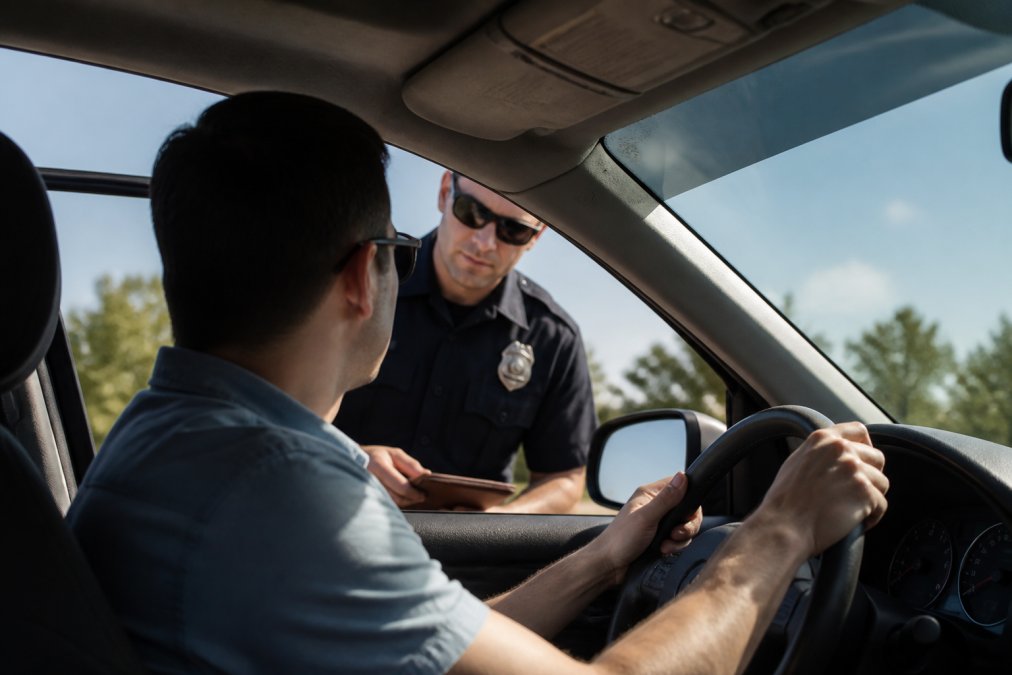
Remaining calm is a tactical necessity. Officers are trained to interpret nervousness and defensive body language as indicators of criminal activity. Speak clearly and respectfully. Keep your hands visible on the steering wheel. Don't make sudden movements. Avoid over-explaining or volunteering information, every word you say can be used against you.
Exercising your right to remain silent
You have a constitutional right to remain silent during a traffic stop, protected by the Fifth Amendment.
Required statements:
- Your license, registration, and proof of insurance when requested
- Your name and address
What you should NOT say:
- Where you're coming from or going
- Whether you had anything to drink
- Whether you were speeding
- Explanations for your driving
- Consent to searches
When an officer asks questions beyond identification and documents, say: "I'm not going to answer questions without speaking to an attorney first." This is direct and legally protective. Your silence cannot be used as evidence of guilt in court.
Can Police Search My Car Without a Warrant
Police generally cannot search your vehicle without a warrant or your consent. Understanding when searches are legal can save you from illegal searches that might still be used against you if you don't challenge them properly.
When consent is required
If an officer asks, "Can I search your car?", you can say no. Your refusal must be clear and unambiguous: "I do not consent to a search of my vehicle." Police will sometimes pressure you after a refusal, but your refusal stands. Your right to refuse is absolute when there's no warrant and no valid exception.
Exceptions to the warrant requirement
Police can search your vehicle without consent in limited situations:
Plain view doctrine: If an officer lawfully sees something illegal in plain view on your seat or visible through the window, they can seize it and search further.
Vehicle inventory search: When police impound your vehicle, they can conduct an inventory search to document contents.
Search incident to arrest: If you're arrested, police can search your vehicle as part of the arrest process.
Probable cause: If an officer has probable cause to believe your vehicle contains evidence of a crime, they can search without consent or a warrant.
Exigent circumstances: In rare emergencies, police can search without a warrant.
When consent is the only basis for a search, your refusal matters. It gives you a defense later if illegal items are found.
Passenger Rights During Traffic Stop
If you're a passenger in a vehicle that's stopped, you have rights too, though more limited than the driver's.
Identification requirements for passengers
Police can ask a passenger for identification. You must provide it if you have it. Beyond that, the same rules apply: you can refuse to answer questions and request an attorney.
When passengers can be ordered out of the vehicle
Police can order passengers out of a vehicle during a traffic stop. However, being ordered out does not mean you've been arrested or that the stop has escalated into a search. You still have your constitutional rights and can still refuse searches.
Your Right to Refuse a Sobriety Test
Field sobriety tests (FST) are physical tests: walk a line, stand on one leg, follow a pen with your eyes. You can refuse an FST with no legal penalty for refusal.
A breath test or blood test is different. If you're arrested for suspected DUI, you can refuse, but California law allows the Department of Motor Vehicles to suspend your license for refusal, even if you're not convicted. The choice depends on your specific situation. What matters is knowing you have the choice.
Common Mistakes That Undermine Your Rights
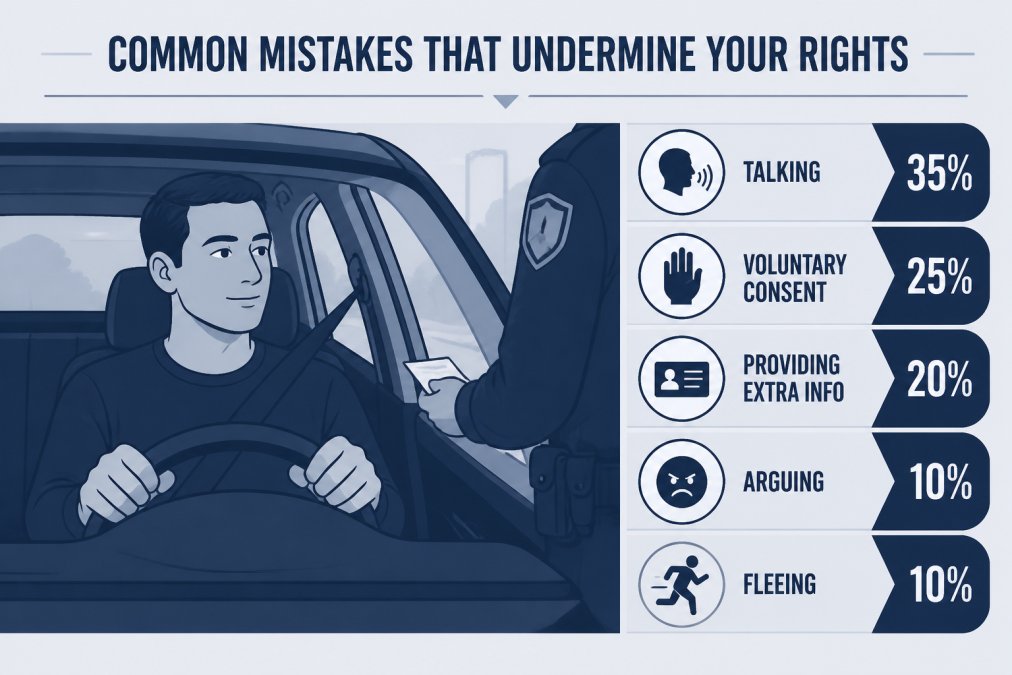
Mistake 1: Volunteering information. You're not required to explain where you're going or why you were speeding. Every word can be used against you.
Mistake 2: Consenting to a search when you don't want one. Saying "sure, go ahead" is the most common way drivers waive their rights.
Mistake 3: Arguing with the officer. If an officer violates your rights, arguing won't fix it. Stay calm, refuse politely, and address violations later with an attorney.
Mistake 4: Not documenting the stop. Note the officer's name, badge number, and patrol car number. Get witness contact information. Record video or audio if possible (laws vary by state).
Mistake 5: Signing documents without reading them. Read anything an officer asks you to sign before signing.
Mistake 6: Believing the officer's legal interpretations. Officers are not lawyers. Your constitutional rights don't depend on what the officer says they are.
What to Do If Your Rights Are Violated
If police violated your rights during a traffic stop, conducting an illegal search, coercing a confession, or using excessive force, you have legal remedies. Act quickly and document everything.
Documenting the stop
Immediately after the stop ends, write down everything you remember: the date, time, location, officer's name and badge number, what was said, what the officer did, and any injuries or damage. If there were witnesses, get their names and contact information. Photograph injuries or vehicle damage. Keep any ticket or citation issued. Save any recording in multiple places.
When to seek legal representation
Contact an attorney immediately if you were arrested, injured by police, subjected to an illegal search, or if you suspect your rights were violated in any way. Do not wait. Evidence degrades and memories fade.
If you've been stopped by police and believe your rights were violated, or if you're facing charges from a traffic stop, you need aggressive legal representation from someone who understands both your constitutional protections and the local Van Nuys Superior Court system. Van Nuys Crime provides personalized defense strategies tailored to your specific circumstances, thorough investigations into police conduct, and skilled negotiation to protect your future. Request a Free Case Evaluation today and learn how we can fight for your rights.
Frequently Asked Questions
What are my legal rights during a police traffic stop in the United States?
You have the right to remain silent beyond providing your driver's license, vehicle registration, and proof of insurance. You can refuse to answer questions about where you're going or what you're doing. You have the right to refuse a search of your vehicle unless the officer has a warrant or you consent. You can ask if you're free to leave. If you're arrested, you have the right to an attorney. Understanding these rights protects you from self-incrimination and unlawful searches.
Can police search my car without a warrant during a traffic stop?
No, police generally cannot search your vehicle without a warrant or your consent. However, exceptions exist: officers may search if they have probable cause to believe evidence of a crime is in the vehicle, if you consent to the search, or in certain emergency situations. You can clearly state 'I do not consent to a search' even if the officer insists. Refusing consent does not give police the right to search, it requires a warrant or one of the narrow exceptions to be valid.
What should I say to police to protect my rights during a traffic stop?
Remain polite and calm. Provide your license, registration, and insurance when asked. For other questions, you can say: 'I do not wish to answer questions without an attorney present' or 'I am exercising my right to remain silent.' If asked to search your vehicle, clearly state 'I do not consent to a search.' Avoid arguing or making sudden movements. Keep your hands visible. These statements protect your legal rights without escalating the situation.
Do passengers have to provide identification during a traffic stop?
Passengers must provide identification if asked by police in most states, though laws vary. However, passengers are not required to answer questions beyond providing ID. Passengers can also refuse consent to searches of the vehicle. Passengers can be ordered out of the vehicle during a traffic stop under certain circumstances. If you're a passenger and unsure of local requirements, it's safer to provide ID while declining to answer other questions and clearly refusing any searches.
This article was written using GrandRanker