 how-to
How Long Does Booking Take? A 2026 Guide
Table of Contents
- How Long Does Booking Take? The Short Answer
- What Happens During Police Booking: Step by Step
- Why Does Jail Booking Take Several Hours? Key Factors
- Jail Release Process Timeline: From Booking to Bond
- How to Find Someone in Los Angeles County Jail
- Can a Lawyer Speed Up the Booking Process?
- Checklist for Families During a Loved One's Arrest
- Conclusion
- Frequently Asked Questions
Last Updated: September 8, 2026
How Long Does Booking Take? The Short Answer
More than 1 in 8 jail bookings stem from a failure to appear warrant, and over half of those individuals have not been convicted of a crime (Prison Policy Initiative, 2026) (prisonpolicy.org). If you or a loved one is facing arrest, the question of how long does booking take is urgent. The booking process is the administrative procedure following an arrest, and it typically takes 2 to 6 hours, though it can stretch longer during busy periods.
Most guides will tell you "it depends." That is true, but not helpful. The reality is that the duration hinges on a handful of predictable factors. Below, we break down the steps, the variables, and exactly what you can expect so you are not left guessing.
What Happens During Police Booking: Step by Step
Police booking is the formal process of recording an arrestee into the jail system. It is a standardized sequence of administrative tasks, each of which takes time. Understanding these steps helps you anticipate the delay and know what is happening on the other side of the wall.
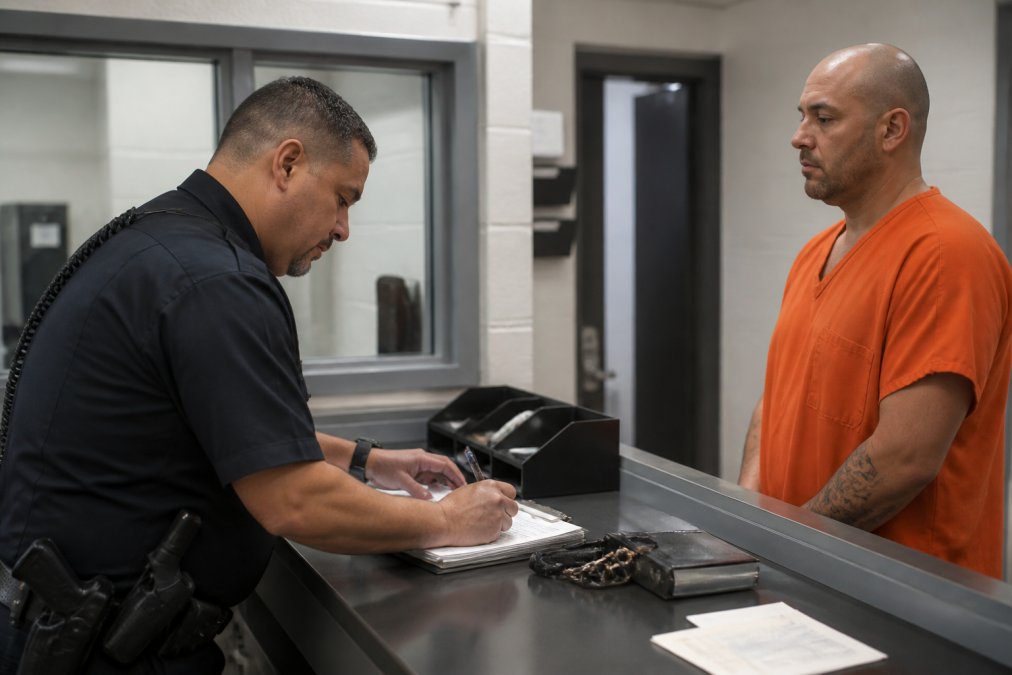
The entire process is designed for accuracy, not speed. Every detail is verified against state and federal databases, and errors here can compromise an entire case. Expect a methodical pace.
Identification, Fingerprinting, and Mugshot
The first phase involves confirming who you are. The booking officer takes your name, date of birth, and other identifiers, then runs a warrant search and background check across criminal record databases. This step is where delays compound, especially if the system is processing a high volume of arrests.
Fingerprinting is now digital in most facilities, but the equipment still requires a clear capture. The mugshot follows. Together, these identification steps typically consume 30 to 60 minutes. If there is an outstanding warrant from another jurisdiction, the process pauses while jail staff coordinate with that agency.
Medical Screening and Property Inventory
Before you enter the general population, jail staff conduct a medical screening to identify injuries, illnesses, or mental health concerns that require attention. This is a liability protection for the facility, but it is also a genuine safety checkpoint. You will answer questions about medications, recent drug or alcohol use, and any suicidal ideation.
Simultaneously, an officer catalogs your personal property. Every item, from a wedding ring to a cell phone, is logged and stored. This inventory must be precise because any discrepancy later becomes a dispute. The medical and property phase adds another 30 to 45 minutes.
Why Does Jail Booking Take Several Hours? Key Factors
The short answer is that booking duration is a function of three interacting variables: the facility's current workload, the specific procedures required for your charges, and the efficiency of the jail's technology. While the national average is 2 to 6 hours, the variance is extreme. A straightforward DUI arrest in a suburban county with a modern, digital intake system might be processed in under 90 minutes. A felony arrest on a Friday night in a major metropolitan jail can easily stretch past 12 hours. Here is the breakdown of what actually drives those numbers.
Time-of-Day and Day-of-Week Variables
Staffing levels are the single most predictable factor. Most county jails operate on a standard 8-hour shift pattern, with the thinnest coverage between 2 a.m. and 6 a.m. An arrest at 3 a.m. means you are waiting for the night-shift booking officer to finish processing the backlog from the evening's bar closures before they even start your paperwork. The day shift, which typically begins around 6 a.m. or 7 a.m., brings a surge of new officers and court transports, which can further delay your processing as staff prioritize moving inmates to their arraignment hearings.
Weekends are another bottleneck. Many courts are closed, which means a person arrested on a Saturday for a non-violent offense may not see a judge until Monday. This effectively extends the 'booking' phase into a multi-day hold in a temporary holding cell, even if the actual administrative processing was completed in two hours. Holiday weekends are the worst case scenario, as staffing is often reduced to minimum levels and the court schedule is further compressed.
Digital vs. Manual Processing: The Technology Factor
The shift from manual paper forms to digital systems has been the most significant change in booking efficiency over the past decade (prisonpolicy.org). In facilities that have fully integrated digital fingerprinting (like the LiveScan system used by the FBI and most state agencies), the identification check that once took 45 minutes can now be completed in under 10 minutes. The officer scans your fingerprints, the system runs a search against the Integrated Automated Fingerprint Identification System (IAFIS), and the results are returned electronically.
However, not every facility has made this transition. Rural counties and older municipal jails may still rely on ink-and-roll fingerprinting, which requires a skilled officer to get a clear print. A poor print means a redo, adding 15 to 20 minutes per attempt. Furthermore, even in digital facilities, the system is only as fast as the network connection. A statewide database outage or a slow connection to the National Crime Information Center (NCIC) can halt the entire process for everyone in the queue.
Facility Type and Charge Severity
The type of facility dictates the process. A city jail holding arrestees for 48 hours before transfer to a county facility will have a streamlined process focused on temporary housing. A county jail, which handles the full spectrum of pre-trial detention, has a more complex intake that includes a more thorough medical screening, a mental health assessment, and a more detailed property inventory.
The severity of your charge also changes the timeline. A misdemeanor arrest with no outstanding warrants might be processed on a 'cite and release' track, where the officer completes the paperwork at the scene and you are given a court date without ever entering a holding cell. A felony arrest triggers a mandatory hold, a more extensive background check, and often a review by a supervisor before you are cleared for general population. The presence of any out-of-state warrants or a parole/probation hold will automatically pause the process while the facility coordinates with the other jurisdiction, which can add hours or even days.
The Overcrowding Multiplier
Jail overcrowding is not just a housing problem; it is a processing problem. When the holding cells are full, new arrestees are often kept in a patrol car or a staging area until a bed opens up. This 'waiting to wait' phase is entirely outside the booking officer's control. In jurisdictions under a federal consent decree for overcrowding, like the Los Angeles County jails have been historically, the intake process is often slowed by the need to medically clear and classify each inmate before they can be moved to a specific housing unit. This is a safety measure, but it is also a time tax on every single arrest.
A Realistic Timeline by Scenario
To move beyond the 'it depends' answer, here are typical ranges based on common scenarios:
Request a Free Case Evaluation →
| Scenario | Typical Booking Time | Primary Delay Factor |
|---|---|---|
| Misdemeanor citation release (no jail stay) | 30-60 minutes | Paperwork at the scene |
| Misdemeanor arrest, weekday, low-volume jail | 1-2 hours | Standard processing |
| Felony arrest, weekday, moderate-volume jail | 3-5 hours | Extended background check & medical |
| Any arrest, Friday/Saturday night, urban jail | 6-12+ hours | Staffing shortage & high volume |
| Arrest with an out-of-county warrant | 12-24+ hours | Inter-agency coordination |
These are not guarantees, but they are grounded in the operational realities of how jails staff their shifts and manage their intake queues. The most important takeaway is that the process is not a single clock; it is a series of sequential gates, and a delay at any single gate resets the expected timeline for the rest.
Jail Release Process Timeline: From Booking to Bond
Once booking is complete, the clock shifts to release. The jail release process timeline depends entirely on whether bail is posted and how quickly the court system moves. For minor offenses, an arrestee might receive a citation and be released within hours. For felony charges, the process extends to arraignment.
The 24-hour cycle is the critical threshold. Law enforcement can hold an individual on probable cause for up to 24 hours before formal charges must be filed (Sahn Law Firm, 2026). After charges are filed, the case moves to a bond hearing or arraignment, where a judge sets or reviews the bail amount.
Posting bail does not guarantee immediate release. The facility must process the payment, verify it, and complete the discharge paperwork. This often takes 2 to 4 additional hours after the bond is posted. Pretrial services may also conduct a release assessment, which adds time for individuals eligible for supervised release.
How to Find Someone in Los Angeles County Jail
If you are trying to locate an arrestee, the most direct method is the official inmate locator. The Los Angeles County Sheriff's Department (LASD) maintains a searchable database of individuals currently in custody. You will need either the person's full name and date of birth or their booking number.
The system updates regularly, but there is a lag. An individual who was booked at 3 a.m. may not appear in the online database until later that morning. If the locator returns no results, call the specific facility directly. The jail staff can confirm whether the person is in custody and provide their housing location.
For families in the Van Nuys area, knowing the correct facility matters. The arrest location determines which jail holds the individual. A call to a legal team can help you navigate this step quickly, as they can often identify where a client is being held.
Can a Lawyer Speed Up the Booking Process?
A lawyer cannot physically accelerate the fingerprinting or medical screening. What an attorney can do is intervene at the legal decision points. If bail has been set, a lawyer can file the paperwork to post it faster and ensure the facility releases the client promptly. If no charges have been filed, counsel can push for a citation release instead of a hold.
The larger value is strategic. A defense attorney identifies weaknesses in the prosecution's case early, which can lead to reduced charges or dismissal before formal filing. Our aggressive defense strategies begin the moment we are retained, not at arraignment. We investigate the arrest, review the probable cause, and challenge unlawful detention where the facts support it.
This is also the moment to protect your record. A lawyer ensures that the arrest does not silently become a conviction because you missed a deadline or accepted a bad plea deal out of fear.
Checklist for Families During a Loved One's Arrest
The hours after an arrest are chaotic. Use this checklist to stay organized and act quickly.
- Confirm the arrest. Call the jail or use the inmate locator to verify the person is in custody.
- Get the booking number. This is required for bail posting and attorney communication.
- Write down the charges. The booking officer will state the alleged offense; record it verbatim.
- Gather identification. You will need the arrestee's full legal name, date of birth, and Social Security number for bail purposes.
- Locate any prescription medications. The facility will confiscate them; you may need to arrange delivery through approved channels.
- Contact a criminal defense attorney. Do not wait for arraignment. Early intervention preserves evidence and options.
- Do not discuss the case on jail phones. All calls are recorded and can be used by the prosecution.
- Preserve evidence. Save text messages, receipts, or witness contact information that may support the defense.
Conclusion
The booking process is a waiting game, but it is not a passive one. Understanding what happens during police booking, the factors that drive delays, and the jail release process timeline puts you in control of the things you can influence. The legal system moves on its own schedule, and your job is to move faster where it counts.
The most consequential decision in the first 24 hours is legal representation. A conviction affects your job, your family, and your freedom for decades. Van Nuys Crime provides personalized legal representation with decades of combined courtroom experience, and we identify weaknesses in the prosecution's case from day one. Request a free case evaluation and get an aggressive defense strategy built around your specific circumstances.
Frequently Asked Questions
How long does booking take at a county jail?
Booking typically takes between 1 and 4 hours, but the process can extend to 8 hours or more during busy periods. The duration depends on the number of arrests ahead of you, whether the facility is overcrowded, and the complexity of the charges. For example, a straightforward DUI with no prior record may process faster than a felony arrest requiring extensive database entry and classification. Over 1 in 8 jail bookings nationwide involve failure-to-appear warrants, which add time for additional verification.
Why does the jail booking process take so long?
The booking process takes time because it involves multiple mandatory steps: identity verification, warrant search, fingerprinting, mugshot, medical screening, and a personal property inventory. Each step requires input from different jail staff and must be completed before you are placed in a holding cell. Nationwide data shows over half of failure-to-appear bookings involve individuals not yet convicted, which means booking officers must carefully check records. On high-volume days, administrative delays from overcrowding can stretch the process well beyond the average.
Can a lawyer speed up the booking process?
A lawyer cannot bypass the jail's mandatory intake procedures, but they can help in meaningful ways. An attorney can call the facility to confirm you are in custody, alert jail staff to any urgent medical needs, and begin working on your release options before booking ends. They can also investigate whether a citation release is appropriate, which may shorten your overall detention. If booking exceeds 48 hours without formal charges, your lawyer can file a legal challenge to secure your release.