 how-to
How to Reschedule a Court Date: Step-by-Step
Last Updated: October 22, 2026
Quick Summary
To reschedule court date, contact the court clerk immediately with your case number and hearing details, request a continuance or postponement, and file a written motion well before your hearing date. Most courts require at least 5 to 10 days' notice, and getting the other party's written agreement significantly improves approval chances.
- Contact the specific department clerk handling your case, not the general courthouse line, and ask about filing deadlines and required procedures.
- File a written motion to continue at least 5 to 10 days before your hearing; last-minute requests are frequently denied.
- Get the other party's signed agreement to the continuance when possible, as stipulated requests are usually approved quickly without a hearing.
- Valid reasons for continuance include medical emergencies, attorney unavailability, inadequate preparation time, and witness unavailability.
- Do not skip your original hearing date unless you receive written confirmation the continuance was granted; missing a hearing can result in bench warrants or default judgments.
Table of Contents
- Can You Reschedule a Court Date?
- Step 1: Contact the Court Clerk Immediately
- Step 2: Get Agreement From the Other Party
- Reasons for Requesting a Court Continuance
- Step 3: File a Written Motion or Request
- Court Continuance Request Letter Template
- How Long Does It Take to Get a New Court Date
- What Happens While Your Request Is Pending
- Frequently Asked Questions
Can You Reschedule a Court Date?
Yes, you can reschedule court date in most cases by requesting a continuance or postponement.
However, rescheduling is not automatic. Failing to appear without a valid request can result in bench warrants, additional charges, or default judgments (My Options).
At Van Nuys Crime, we help clients navigate these procedures correctly.
Act quickly: most courts require a continuance request well before your hearing date, and waiting until the last minute makes approval less likely.
Step 1: Contact the Court Clerk Immediately
Your first move is to contact the clerk's office for the department handling your case, not a general courthouse line. The Van Nuys courthouse houses multiple departments across criminal, civil, family law, small claims, and traffic calendars, each with its own continuance practice.
Before you call, pull these items from your case paperwork:
- Your case number and the name of the assigned judicial officer
- The department number printed on your hearing notice
- The date, time, and courtroom for the current hearing
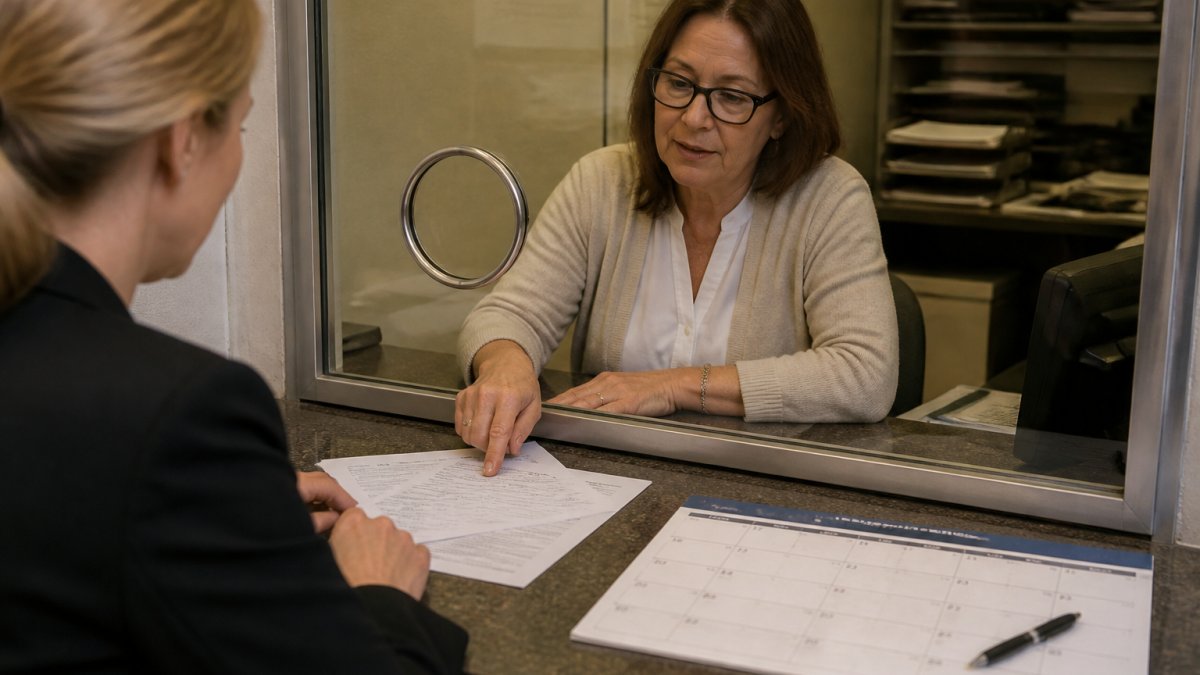
Ask the clerk these specific questions, and write down the answers:
- What is the last day to file a continuance request for this department?
- Does this department accept requests by phone, e-filing, mail, or in person only?
- Which local form or pleading format does this department require?
How case type changes the channel
The biggest mistake is assuming every case type follows the same path. In practice:
- Criminal and traffic matters often route through the courtroom clerk and may require a written request filed with the department, with the prosecutor's position noted. For infractions, some departments allow a request at the clerk's window or through the court's online portal.
- Civil matters typically require a written ex parte application or motion to continue, filed with proof of service on all parties, and may require a reservation through the court's reservation system.
- Family law matters frequently require a Request for Order or a stipulation and order, and departments may require you to meet and confer first.
Ask the clerk directly: "Which procedure applies to my case type in this department?" If they cannot answer, ask for the courtroom assistant or check the court's self-help pages.
Confirm current details before you rely on them
Courthouse phone numbers, hours, filing windows, and e-filing rules change. Verify current contact information and filing options on the court's official website or by calling the department directly, do not rely on an older article, including this one.
If you are unsure which department or procedure applies, get help before the deadline. A wrong filing channel can result in a rejected request and a missed hearing.
Step 2: Get Agreement From the Other Party
In most cases, the other party's agreement makes approval much easier. If both sides agree to postpone, judges usually grant the request.
Contact the other party (or their attorney) as soon as possible and explain why you need a continuance.
If the other party agrees, ask them to sign a written "stipulation to continue" or "stipulated continuance" consenting to the new date; courts almost always approve these immediately.
Reasons for Requesting a Court Continuance
Courts approve continuance requests for legitimate reasons. Valid reasons include:
- Medical emergencies or illness, You or a family member has a serious health issue requiring immediate attention
- Attorney unavailability, Your lawyer has a conflict or is out of town on an important case
- Inadequate preparation time, You need more time to gather evidence, interview witnesses, or prepare your defense strategy
Weak reasons include vague statements like "I'm not ready" or "I forgot about the hearing." Judges see these excuses regularly and often deny them. Be specific. Provide documentation when possible.
If you're facing serious felony charges, the stakes are high. Van Nuys Crime builds strong justifications backed by evidence.
Step 3: File a Written Motion or Request
Contact the court clerk for the correct form, many courts have templates online or in person.
Your written request must include:
- Your case number and name
- The current hearing date
- Your requested new date (if you have one)
Be clear and professional. Use plain language. Avoid emotional language or complaints about the other party. Judges respond to factual, organized requests.
Submit the request well before your hearing date.
Keep proof of filing, a stamped copy or receipt from the clerk proves you acted in time.
Court Continuance Request Letter Template
Use this template to write your own continuance request letter.
[Your Name] [Your Address] [Your Phone Number] [Your Email]
[Date]
Request a Free Case Evaluation →
Clerk of the Court [Court Name and Address]
RE: Request for Continuance Case No.: [Your Case Number] Hearing Date: [Current Scheduled Date]
Dear Clerk of the Court,
I respectfully request a continuance of my hearing scheduled for [date].
The reason for this request is [state your specific reason clearly]. [Provide one or two sentences of detail. For example: "I have a documented medical appointment that cannot be rescheduled" or "My attorney became available only recently and needs time to review discovery materials."]
I am prepared to appear on the rescheduled date and will comply with all court orders.
Thank you for your consideration.
Respectfully,
[Your Signature] [Your Typed Name]
Print two copies. Sign both. File one with the court and keep one for your records.
How Long Does It Take to Get a New Court Date
There is no single answer: the timeline depends on how far in advance you file, whether the other side agrees, and how backed up the department's calendar is. Match your situation to the right path below.
If your hearing is more than two weeks away
File as early as the department allows. Most departments require a minimum notice period, commonly several court days, more for certain motion types. Filing early gives the clerk time to process, the judge time to rule, and you time to fix a rejected filing. Expect a decision within roughly one to two weeks for a contested written request, faster for a stipulated one.
If your hearing is days away
This is where most people lose. Options narrow sharply:
- Call the department immediately and ask whether the judge hears same-week requests and what the absolute filing cutoff is.
- Check whether your case type allows an ex parte application, a shortened-notice request asking the judge to rule quickly. Civil and family departments often have specific ex parte windows and require notice to the other side by a set time the day before.
- Prepare to appear anyway. A last-minute request is frequently denied or not heard before the hearing date, and showing up to explain in person is often more effective than a request the judge never sees in time.
If the other side agrees
A stipulated continuance, signed by both parties, is usually the fastest path. Departments often grant these without a hearing, sometimes within a few business days, because the judge is not being asked to resolve a dispute. File the stipulation, keep a stamped copy, and confirm the new date in writing before treating the old date as cancelled.
If the other side objects
The judge must decide, which takes longer. Expect the department to set a response deadline for the objecting party and then rule on the papers or at a short hearing. A realistic range is roughly one to three weeks, but backlogs can push it longer. Build in time to appear on the original date if the ruling does not come first.
If the date has already passed
A missed date is a different problem from a future one, and the fix depends on case type:
- Criminal or traffic: contact the department and your attorney immediately. The court may have issued a bench warrant or added a failure-to-appear charge; a request to recall the warrant or vacate the forfeiture is typically handled by motion, and timing matters.
- Civil: a default or dismissal may have been entered. Relief usually requires a motion to set aside the default or dismissal, filed within the statutory time, showing the reason for the missed date.
- Small claims and family: ask the clerk what the department requires to reset a missed hearing; some allow a simple request, others require a motion.
Do not wait to see what happens, the longer a missed date sits, the more expensive and difficult the fix becomes.
What the new date will look like
You will rarely get your first-choice date. The court assigns the next available slot that fits the judicial officer's calendar, and busy departments can push a new hearing out by weeks or months. Ask the clerk for the department's typical lag between a granted continuance and the new hearing, and plan around that window rather than your preferred date.
What Happens While Your Request Is Pending
Your original hearing date stays on the calendar until the judge approves the continuance.
If you are in custody, the process is different: your attorney must file the request, so make sure your lawyer knows immediately.
For serious felony charges, every day matters. Van Nuys Crime acts fast and files continuance requests strategically.
Rescheduling a court date requires careful attention to procedure and deadlines.
If you're facing court proceedings and need help navigating continuance requests or preparing your defense, Van Nuys Crime is ready to assist. Our team has extensive experience with the Van Nuys courthouse system and knows how to present continuance requests effectively, from initial filing to representing you at every hearing. Request a Free Case Evaluation today to discuss your specific situation and protect your rights.
Frequently Asked Questions
What's a good excuse to reschedule a court date?
Valid reasons to reschedule a court date include serious illness or hospitalization, death in the family, unforeseeable work obligations, or attorney unavailability. The judge must approve your request, and vague or weak reasons are often denied. Document your reason with supporting evidence, medical records, death certificate, or employer letter. Frivolous excuses harm your credibility with the court and may result in a bench warrant if you fail to appear.
Can I reschedule a court date by calling the courthouse?
You can call the court clerk's office to inquire about rescheduling and ask about procedures, but most courts require a formal written request or motion filed before they will approve a continuance. A phone call alone does not officially reschedule your hearing date. Always follow up with written documentation and serve the other party as required by court rules. Verify your specific court's procedures when you call.
How many times can you postpone your court date?
There is no fixed limit to the number of continuances, but judges have discretion to deny repeated requests. Most courts discourage excessive postponements, and judges may view multiple requests as an attempt to delay proceedings unfairly. Each request must have a legitimate reason. Repeated denials or suspicious timing can damage your case credibility and may prompt the judge to hold you in contempt of court or issue a bench warrant.
Do I still have to attend court if I have requested a new date?
Yes, you must appear on the originally scheduled date unless your continuance request is approved in advance. If your request is denied and you fail to show up, the judge may issue a bench warrant for your arrest or proceed without you, which can result in default judgment or conviction. Always assume you must attend until you receive written confirmation that the hearing has been postponed. Verify the new date before relying on a continuance approval.