 ultimate-guide
Defense Strategies for Violent Crime Charges: A Legal Guide
Table of Contents
- Understanding Defense Strategies for Violent Crime Charges
- Self-Defense Laws by State and How They Apply
- Challenging Prosecution Evidence and Police Misconduct
- Constitutional Rights Criminal Defense and Pre-Trial Motions
- Alibi Defense and Witness Testimony Cross-Examination
- Consequences of Violent Crime Conviction and Sentencing Mitigation
- False Accusation Violent Crime: Proving Your Innocence
- Plea Bargaining and Negotiated Settlements vs. Trial
Defense Strategies for Violent Crime Charges: A Legal Guide
Last Updated: July 25, 2026
When facing violent crime charges, understanding defense strategies can mean the difference between conviction and acquittal. At Van Nuys Crime, we've spent years defending clients accused of everything from assault to homicide, and we've seen firsthand how the right legal strategy dismantles weak prosecution cases. The stakes are extraordinarily high, your future, your reputation, your family's financial security all hang in the balance. Below, we'll walk you through the most effective defense strategies for violent crime charges and what you need to know to protect yourself.
Understanding Defense Strategies for Violent Crime Charges
The foundation of any violent crime defense rests on a single principle: the prosecution bears the burden of proof. They must prove guilt beyond a reasonable doubt, not "pretty sure," but to such a degree that a reasonable person would act on that conviction in matters of importance to themselves. A single gap in their evidence, one inconsistency in witness testimony, or one procedural violation by police can create the reasonable doubt that sets you free.
Building reasonable doubt requires thorough investigation, expert analysis, and strategic presentation. Van Nuys Crime examines police reports for procedural violations, hires forensic experts to challenge physical evidence, prepares cross-examination strategies to expose inconsistencies in witness testimony, and files suppression motions to keep illegally obtained evidence out of trial. The goal isn't to prove you're innocent, it's to prove the prosecution hasn't met their constitutional obligation to prove guilt beyond a reasonable doubt.
Self-Defense Laws by State and How They Apply
Self-defense is one of the most powerful defenses available for violent crime charges, but it only works if you understand your state's specific laws. California, where Van Nuys Crime operates, has some of the most defendant-friendly self-defense statutes in the nation.
Under California law, you have the right to use reasonable force to defend yourself from imminent harm. The threat must be immediate and real, not speculative or future. Reasonable force means the amount necessary to stop the threat, no more, no less. Courts look at what the defendant knew at the moment, not what was actually true. If you reasonably believed deadly force was necessary to stop an imminent threat of death or serious injury, self-defense applies even if the threat turned out to be less serious than you thought.
Justification Defense and Reasonable Force
Justification differs from self-defense. While self-defense protects you when defending yourself from harm, justification protects you when defending someone else or preventing a crime. California recognizes both. Defense of others works the same way as self-defense, you can use reasonable force to protect another person from imminent harm without needing a relationship to that person or their permission.
The critical question is always: what did the defendant know at the moment? If you saw what you reasonably believed was an armed robbery and used force to stop it, that's justified, even if the "weapon" was a toy gun. Your actions are judged based on what you knew then, not what we know now.
Defense of Others and Imminent Harm
Imminent harm means a threat happening right now, not later. Courts have consistently held that imminent means immediate. However, "imminent" doesn't require the threat to be seconds away. If someone is actively committing a violent felony or has a weapon and is positioning themselves to use it, the harm is imminent. The question is whether a reasonable person in your position would have believed the threat was immediate enough to justify using force.
Challenging Prosecution Evidence and Police Misconduct
Police make mistakes. They violate constitutional rights. They mishandle evidence. They coerce confessions. When they do, the evidence they obtain becomes inadmissible, and without that evidence, their case collapses.
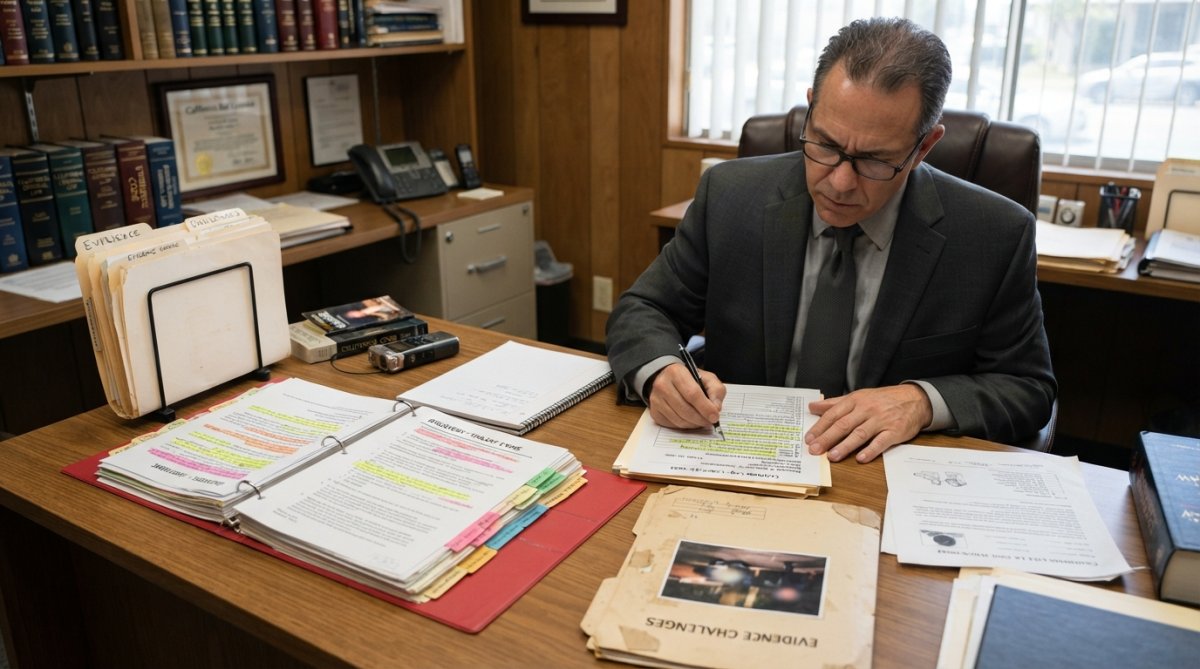
The suppression motion is your primary tool. It's a pretrial motion that asks the judge to exclude illegally obtained evidence from trial. If police violated your Fourth Amendment rights when searching your home, that evidence gets suppressed. If they violated your Fifth Amendment rights by interrogating you without reading your Miranda rights, your confession gets suppressed. A suppression motion that excludes key evidence often destroys the prosecution's case entirely.
Suppression Motions and Fourth Amendment Violations
The Fourth Amendment protects you from unreasonable searches and seizures. Police can't search your home, car, or person without a warrant or valid exception. If they do, anything they find is inadmissible.
Common Fourth Amendment violations include searching your home without a warrant, stopping your car without reasonable suspicion, extending a traffic stop beyond its original purpose, searching your phone without a warrant, and using excessive force during arrest. Each can be challenged with a suppression motion. The burden is on the prosecution to prove the search was constitutional. If they can't, the evidence is excluded.
Chain of Custody and Digital Evidence Forensics
Physical evidence is only admissible if the prosecution can establish chain of custody, a clear, unbroken record of who had the evidence, when, and what they did with it. Gaps, mishandling, or broken chains result in exclusion.
Digital evidence creates additional challenges. Digital forensics is complex, and chain of custody for digital evidence is notoriously difficult to establish. We've successfully challenged digital evidence by exposing errors in forensic analysis, demonstrating improper handling, or showing that data was altered after collection.
Constitutional Rights Criminal Defense and Pre-Trial Motions
Your constitutional rights are your shield against government overreach. When police violate those rights, the evidence they obtain becomes inadmissible.
Fifth Amendment Protection and Due Process
The Fifth Amendment gives you the right to remain silent. Police cannot compel you to testify against yourself. If you invoke this right, they must stop immediately. Anything you say after invoking your right to silence is inadmissible.
Due process requires the prosecution to follow proper procedures: disclose exculpatory evidence, allow adequate time to prepare your case, and provide opportunity to cross-examine witnesses. Violations can result in dismissal or conviction reversal.
Exculpatory Evidence and Discovery Process
Exculpatory evidence proves your innocence or undermines the prosecution's case. The prosecution must disclose all exculpatory evidence to the defense. Withholding it is a Brady violation, a serious constitutional violation resulting in dismissal or reversal.
The discovery process lets you obtain the prosecution's evidence before trial, reports, witness statements, physical evidence, and expert reports. Many cases are won during discovery. Police reports may show key witnesses had criminal histories. Forensic reports may show evidence was mishandled. Surveillance footage may show the prosecution's timeline was impossible.
Alibi Defense and Witness Testimony Cross-Examination
An alibi defense is straightforward: you weren't at the scene of the crime. You were somewhere else. This directly contradicts the prosecution's case and is one of the most powerful defenses available.
However, alibi defenses require solid evidence. Witnesses must be credible with detailed, specific testimony. Vague testimony doesn't work; specific testimony ("I was with him from 3 PM to 6 PM, we watched the game together") is powerful. Corroborating evidence, phone records, credit card transactions, surveillance footage, multiple witnesses, reinforces the alibi.
Cross-examination exposes witness unreliability. Memory is fallible. People misidentify suspects and are influenced by leading questions. A skilled cross-examination can demonstrate that identification was based on poor lighting, a brief glance, or a suggestive police lineup, or that memory was contaminated by media coverage or conversations with other witnesses.
Consequences of Violent Crime Conviction and Sentencing Mitigation
A conviction for assault can result in years in prison and a permanent criminal record. A conviction for homicide can mean life without parole. Beyond the immediate sentence, a violent crime conviction destroys your future, employment becomes nearly impossible, housing discrimination is legal against felons, professional licenses are revoked, and you lose voting rights and firearm possession rights.
This is why sentencing mitigation matters enormously. Even if conviction seems likely, the difference between a 5-year and 15-year sentence is enormous. Sentencing mitigation involves presenting evidence supporting a lower sentence: your background, character, potential for rehabilitation, and family circumstances.
Post-Conviction Mitigation and Mental Health Evaluations
Post-conviction mitigation begins when charges are filed. It includes psychological evaluations explaining your mental state at the time of offense, your history of trauma or abuse, your mental health conditions, and your rehabilitation potential.
A psychological evaluation can be transformative. If you suffered severe trauma, have PTSD, or have a mental health condition that affected your judgment, this evidence can dramatically reduce your sentence. The evaluation must explain the connection between the condition and the offense and address your potential for treatment and rehabilitation.
False Accusation Violent Crime: Proving Your Innocence
False accusations happen more often than most people realize. Someone misidentifies you, lies to police, or fabricates evidence. When accused of a violent crime you didn't commit, your defense strategy changes fundamentally.
Proving your innocence requires affirmative evidence, not just attacking the prosecution's case. You need evidence that someone else committed the crime, that the accuser has a motive to lie, that identification was unreliable, or that physical evidence doesn't match you.
Expert Witnesses and Psychological Evaluations
Expert witnesses are critical in false accusation cases. Forensic experts can testify that DNA evidence doesn't match you. Eyewitness identification experts can testify about identification unreliability. Psychologists can testify about false confessions and memory contamination.
A psychological evaluation of the accuser can be valuable if they have a history of false accusations, a motive to lie, or a mental health condition affecting reliability. However, expert witnesses are expensive and must be carefully prepared with legitimate credentials, real experience, and the ability to communicate complex concepts clearly to a jury.
Plea Bargaining and Negotiated Settlements vs. Trial
Not every case goes to trial. Many are resolved through plea bargaining, negotiations with the prosecution to reduce charges or recommend a lower sentence in exchange for a guilty plea.
The prosecution doesn't want to risk trial. They might reduce a violent felony to a misdemeanor, agree to recommend probation instead of prison, or dismiss some charges in exchange for a guilty plea to others. However, a guilty plea is final. You waive your right to trial, cross-examine witnesses, and appeal on most grounds. You must be certain the plea bargain is better than the risk of trial.
| Decision Factor | Plea Bargain | Trial |
|---|---|---|
| Certainty of Outcome | Certain (known sentence) | Uncertain (jury decides) |
| Time to Resolution | Weeks to months | Months to years |
| Cost | Lower attorney fees | Higher attorney fees |
| Collateral Consequences | Certain conviction record | Possible acquittal |
| Appellate Rights | Limited | Broader grounds |
Van Nuys Crime evaluates every case for trial readiness. If we believe we can win at trial, we'll tell you. If we believe a plea bargain is in your best interest, we'll tell you that too. The decision is always yours, made with full information about your options.
Trial is appropriate when the prosecution's case is weak, key evidence is inadmissible due to constitutional violations, witness credibility is compromised, you have a strong affirmative defense like self-defense, or the potential sentence is severe enough to justify the risk.
Plea bargaining is appropriate when the prosecution's evidence is strong, trial would be extraordinarily expensive, the plea bargain significantly reduces the potential sentence, collateral consequences are less severe with the reduced charge, or you have limited resources for a lengthy trial.
Facing violent crime charges is terrifying, but you don't face it alone. The right defense strategy, executed by experienced attorneys who understand both the law and your local courts, can change everything. Van Nuys Crime has spent decades defending clients in these situations, identifying weaknesses in prosecution cases, challenging unconstitutional evidence, and fighting relentlessly for the best possible outcome. Whether your path leads to trial or negotiated settlement, we ensure you understand your options, your rights, and your realistic chances of success. Request a free case evaluation today and let us show you how aggressive, personalized representation actually works.
Frequently Asked Questions
What are the most effective defense strategies for violent crime charges?
Defense strategies for violent crime charges vary based on your specific circumstances. Common approaches include challenging the prosecution's evidence through suppression motions, establishing reasonable doubt via witness testimony and expert analysis, raising affirmative defenses like self-defense or defense of others, and identifying constitutional rights violations. Your attorney may also pursue plea negotiations if that serves your best interests. The most effective strategy depends on the facts, evidence strength, and statutory requirements of your case.
How do self-defense laws by state protect me from violent crime charges?
Self-defense laws vary significantly by state but generally allow you to use reasonable force to protect yourself or others from imminent harm. Most states recognize justification defenses when you reasonably believed force was necessary. Some states follow 'duty to retreat' rules, while others have 'stand your ground' laws. An experienced criminal defense attorney understands your state's specific statutory requirements and can argue whether your actions met the legal threshold for self-defense, potentially resulting in acquittal or dismissal.
What happens if I'm falsely accused of a violent crime?
A false accusation of violent crime requires aggressive defense through evidence examination, witness credibility challenges, and expert testimony. Your attorney will scrutinize the accuser's account, identify inconsistencies, and present exculpatory evidence. Psychological evaluations may demonstrate motive for false accusation. Police misconduct, chain of custody problems, and digital evidence forensics can further undermine the prosecution's case. Building reasonable doubt through cross-examination and expert witnesses is critical when facing false allegations.
What are the consequences of a violent crime conviction on my future?
Consequences of violent crime conviction are severe and long-lasting. Felony convictions result in prison time, fines, probation, and permanent criminal records affecting employment, housing, professional licensing, and educational opportunities. You may lose voting rights and firearm ownership rights. Victim restitution and civil liability are common. Post-conviction mitigation, including mental health evaluations and rehabilitation programs, can influence sentencing. Understanding these stakes underscores why robust legal defense during trial is essential to avoid conviction altogether.
This article was written using GrandRanker