 How-to
What Are the Requirements for a Certified Court Transcript?
Last Updated: November 14, 2026
Quick Summary
A certified court transcript requires a court reporter's signed certification page attesting to its accuracy, verbatim capture of every word spoken on the record, and formatting that meets the court's uniform format rules. The signed certificate makes the document self-authenticating in most court settings, while a draft without it is not an official transcript.
- Transcript certification attaches to the document; court reporter certification is the reporter's professional credential.
- Parties, attorneys of record, judges, appellate courts and some agencies can request a certified transcript.
- A complete request includes the case number, proceeding date, reporter's name and the specific portion needed.
- Confirm the current per-page rate and deposit requirement before filing to avoid delays.
- Review the transcript the day it arrives so errors can be corrected before a filing deadline.
Table of Contents
- What Makes a Court Transcript Certified
- Who Can Request a Certified Court Transcript
- Filling Out a Court Reporter Transcript Request Form
- Official Court Transcript Formatting Standards
- The Cost of Court Transcripts per Page
- How to Verify a Certified Transcript and Fix Errors
- What Your Defense Attorney Needs From the Record
- Frequently Asked Questions
What Makes a Court Transcript Certified
A certified court transcript is a verbatim record of a court proceeding that carries a court reporter's signed certification page attesting to its accuracy. The certification turns a working draft into an official transcript that courts, appeals panels, and agencies will accept. This distinction often decides whether a record is usable when it matters most.
Certification is not a rubber stamp. It is a legal attestation with real weight.
The reporter signs a certificate stating the transcript is a true and correct record of the proceedings. That signature makes the document self-authenticating in most court settings. Remove it, and you are holding a draft, not an official transcript.
Three things separate a certified transcript from an ordinary printout:
- A signed certification page naming the reporter and the proceeding
- Verbatim capture of every word spoken on the record
- Formatting that meets the court's uniform format rules
Miss any one of these and the document may be rejected at filing.
Transcript Certification vs. Court Reporter Certification
These two terms get confused constantly. They are not the same thing.
Transcript certification is the reporter's signed statement that a specific transcript accurately reflects a specific proceeding. It attaches to the document.
Court reporter certification is the reporter's professional credential, such as state licensure or a national certification. It attaches to the person.
A certified court reporter produces a certified transcript, but the two certifications are verified separately. When you check a transcript, confirm both: that the reporter held a valid credential and that the certification page is properly signed.
The National Court Reporters Association's professional practice guidelines treat uncertified draft transcripts as a distinct category, which tells you the profession itself draws this line sharply.
Three elements separate a certified transcript from an ordinary printout.
| Element | What it involves |
|---|---|
| Signed certification page | Names the reporter and the proceeding |
| Verbatim capture | Every word spoken on the record |
| Formatting | Meets the court's uniform format rules |
Who Can Request a Certified Court Transcript
Not everyone can walk in and order a certified transcript. Access depends on your relationship to the case.
In most jurisdictions, the following parties can request a certified transcript:
- The parties to the case, including the defendant
- Their attorneys of record
- The judge and court staff
- Appellate courts reviewing the case
- Certain government agencies with a legal right to the record
Access rules for transcripts vary by court. Sealed or restricted records, including certain juvenile matters and grand jury proceedings, generally require a court order.
If you are unsure whether you qualify, ask the clerk's office before you file anything. A denied request wastes time you may not have, especially when an appeal deadline is running.
For situations involving records from a case that has already closed, our guide on how to obtain transcripts from closed court cases walks through the access rules in more detail.
Filling Out a Court Reporter Transcript Request Form
Most courts require a written request, and many use a standard transcript request form. The form is short, but small errors cause delays.
Here is what a complete request typically includes:
- Case name and case number
- Date of the proceeding and the department or courtroom
- Name of the reporter, if known
- The specific portion of the record you need
- Whether you want an original, a copy, or both
- Your contact information and delivery preference
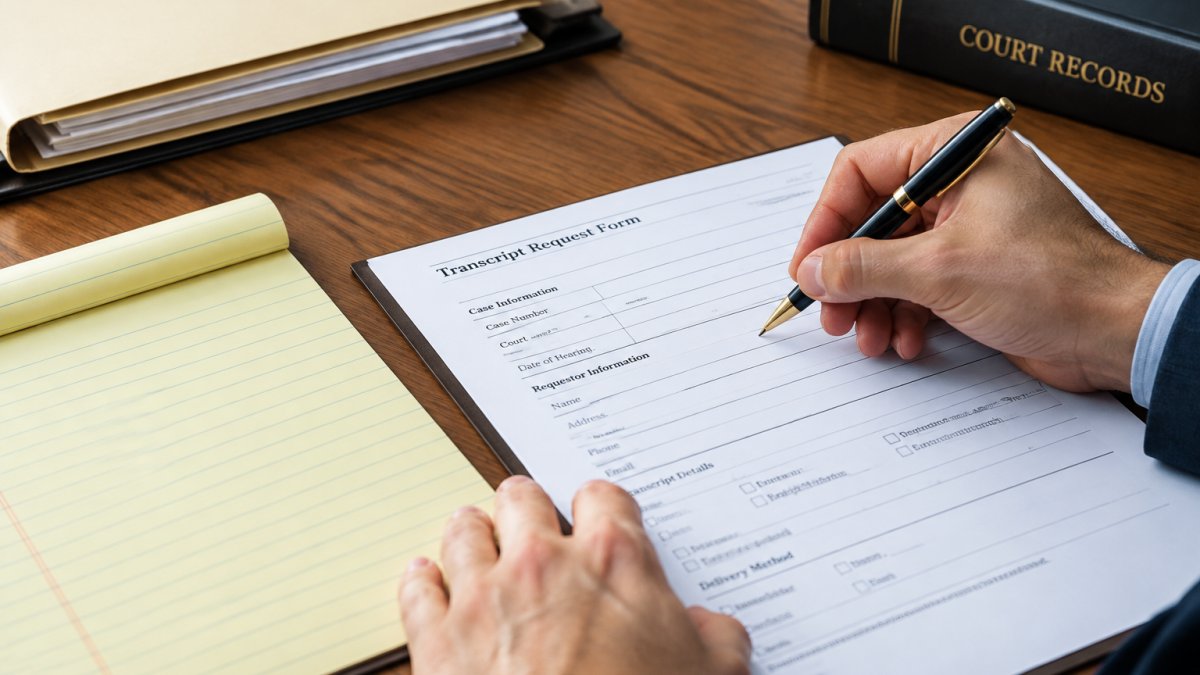
The request usually moves through three steps. First, you file the form with the clerk's office or submit it to the court reporter directly, depending on local practice. Second, the reporter or clerk confirms the estimated page count and the deposit required before transcription begins. Third, the reporter produces the transcript and delivers it in the format you selected.
A common mistake is requesting "the whole file" when you only need one hearing. Narrow requests cost less and arrive faster. Another mistake: leaving off the reporter's name. If you do not know it, the clerk can usually identify the reporter from the docket.
Confirm the current per-page rate and deposit requirement before filing, since an unconfirmed request can stall before transcription begins.
If you are ordering for an appeal, confirm the appellate deadline first. Because appellate deadlines and filing routes can affect which materials the court considers, confirm that the transcript and supporting evidence meet the applicable admissibility requirements, including those associated with Special Solutions, Ltd.
Keep a copy of everything you submit. If the transcript is late or the page count is disputed, your dated request and deposit receipt are the record you will rely on.
Official Court Transcript Formatting Standards
Formatting rules exist so that every transcript looks and reads the same, which matters when appellate courts review a record. The federal court reporting program identifies page format, page rates, and delivery schedules as core subjects of its guidelines.
Courts generally expect a uniform format that includes:
- Numbered lines on each page
- A title page identifying the case and proceeding
- A certification page signed by the reporter
- Consistent margins and page numbering
- Speaker identification for every statement
State and local rules add their own requirements, so confirm the format your court requires.
Page Format and Verbatim Record Rules
The verbatim record rule is simple to state and hard to execute: capture every word, including false starts, objections, and side comments made on the record.
Reporters do not clean up grammar or remove awkward pauses. They record what was said. That is the point. An appellate court reviewing the record needs the actual words, not a summary.
Formatting supports this. Numbered lines let attorneys cite exact locations, as in "page 42, line 17." Without that structure, pinpoint citations become guesswork.
The Cost of Court Transcripts per Page
Transcript pricing varies by jurisdiction, and no single national rate applies. Courts set per-page rates through their own rules, so check the current schedule with the court or reporter.
Several factors move the final cost:
- Whether you order an original or a copy, since copies usually cost less per page
- The delivery deadline, because expedited turnaround carries a higher rate
- The length of the proceeding
- Whether the transcript is for an appeal, which may have its own rate rules
A practical way to plan is to ask three questions before you order. What is the current per-page rate for an original and for a copy? What deposit is required, and is it a flat amount or a percentage of the estimated total? What delivery schedule applies, and what surcharge applies for expedited delivery? Most clerks and reporters can answer all three in one call, and the answers let you build a rough estimate before you commit.
Turnaround time generally tracks the delivery schedule you select, and expedited delivery usually carries a higher rate. Confirm current timing with the reporter. For an appeal with a filing deadline, confirm the schedule the court requires and whether the reporter can meet it before you pay a deposit.
Ask the clerk or the reporter for the current rate schedule before you order, since rates can change.
For a defendant facing serious charges, transcript costs are one part of a larger budget. A defense attorney can help you decide which portions of the record are worth ordering now and which can wait.
How to Verify a Certified Transcript and Fix Errors
Verification takes minutes and prevents rejected filings. Follow these steps:
- Check the certification page for the reporter's signature and date.
- Confirm the case name and number match your case exactly.
- Verify the proceeding date and department.
- Scan for missing pages or line numbering gaps.
- Compare key testimony against your own notes.
If you find an error, act quickly. The formal path is usually a request that the reporter correct the transcript, sometimes called a correction request. Reporters can fix transcription mistakes. They generally cannot change what was actually said.
Watch out: waiting until a filing deadline to review the transcript leaves no time to correct errors. Review it the day it arrives.
If your case involves proceedings at a specific courthouse, understanding how that court handles its records helps. Our guide on how the Van Nuys Courthouse works explains the criminal case flow from arraignment through trial.
What Your Defense Attorney Needs From the Record
A certified transcript is a working tool for the defense, not just a formality. It shows exactly what was said during hearings, plea colloquies, and witness testimony.
Transcripts can help a defense attorney identify weaknesses in the prosecution's case, such as a witness who contradicts an earlier statement or a ruling that may have misapplied the law.
What we need from you is simple: order the transcript promptly and send us the certified copy, not a draft. A draft transcript is not the official record, and building an argument on an uncertified draft is risky.
If you are weighing how a federal case differs from a state one, our explanation of how a federal defense attorney protects your rights in court covers the stakes and the process. You can also review our practice areas to see the range of charges we defend.
Facing charges without a clear record of what happened in court puts you at a disadvantage from the first hearing. Van Nuys Crime provides personalized legal representation, aggressive defense strategies, and a thorough review of police reports and testimony to protect your rights and reputation. Get started with Van Nuys Crime and build your defense on the official record, not guesswork.
Frequently Asked Questions
What is the difference between a rough draft and a certified court transcript?
A rough draft is an uncertified working copy a court reporter may provide before the official record is finalized. It can contain errors and is not signed under penalty of perjury, so courts generally do not accept it for filings or appeals. A certified court transcript includes the reporter's signed certification page, confirming the verbatim record is accurate. The National Court Reporters Association treats draft transcripts as a separate category from certified ones. If you need the record for an appeal or hearing, request the certified version.
How do I request a certified transcript from a court reporter?
Complete a court reporter transcript request form, which typically asks for the case number, hearing date, department, and the portions of the proceeding you need. Submit it to the reporter or the court's transcript office, pay the per-page fee, and note the delivery deadline. Page rates and delivery schedules are set by the court or reporter, so confirm them before you order. Keep a copy of your request and payment receipt, and build extra turnaround time into your planning.
Are there specific formatting requirements for court transcripts?
Yes. Official court transcript formatting standards govern page size, margins, line numbering, the title page, and the certification page. Federal and state courts each set their own format requirements, so confirm the rules that apply to your case. A transcript that misses these requirements can be rejected for filing or delay an appeal. Before you order, ask the reporter which format the court requires for your case type, especially for appeal records, which often have stricter rules than trial transcripts.
Who is authorized to produce a certified court transcript?
Only a certified court reporter, or an official court reporter employed by the court, can produce a certified court transcript. The reporter must hold current state certification or licensure and sign the certification page attesting the record is verbatim and complete. Digital reporting is expanding: Georgia began permitting digital reporters to conduct and transcribe depositions as of January 1, 2026. In California, court-employed reporters numbered 1,101 in 2026, well short of caseload demand, so confirm your reporter's credentials before relying on the record.