 how-to
What Happens If You Violate a Domestic Violence Restraining Order
Table of Contents
- What Counts as a Restraining Order Violation
- Penal Code 273.6 Violation: The California Statute Behind the Charge
- Restraining Order Violation Jail Time and Fines
- How Enforcement Works: Arrest, Bail, and the District Attorney
- Defenses for Restraining Order Violations
- Interstate Enforcement and Impact on Child Custody
- Frequently Asked Questions
Last Updated: September 13, 2026
What Counts as a Restraining Order Violation
What happens if you violate a domestic violence restraining order is straightforward: a violation occurs when a person bound by a court order does something the order explicitly forbids, such as contacting the protected party, approaching their home or workplace, or possessing firearms. The violation itself is a separate criminal offense, even if no new act of violence occurs. In one recent reporting year, authorities recorded 2,636 arrests tied to allegations of a domestic violence restraining order violation, and 1,394 of those arrests involved charges of only violating the order, according to New Jersey restraining order violation arrest data.
Acts That Trigger a Violation
Courts draft protective orders with specific prohibitions, and each one can become the basis for a criminal charge. Common triggers include:
- Direct contact by phone, text, or in person
- Showing up at a protected person's home, job, or school
- Sending messages through a third party
- Threatening, stalking, or harassing conduct
- Violating a stay-away distance or firearm surrender term
Digital Evidence and Electronic Communication Violations
Electronic communication is where most modern violations get charged. A single text, social media message, or voicemail can establish contact even when no physical encounter happens. Prosecutors treat screenshots, call logs, and location data as evidence collection tools, and a no-contact order covers digital channels just as it covers physical ones. What most people miss is that deleting the message does not delete the carrier record.
Penal Code 273.6 Violation: The California Statute Behind the Charge
Penal Code 273.6 is the California statute that makes willful disobedience of a protective order a crime. A Penal Code 273.6 violation requires proof of four things: a valid court order was in effect, the defendant knew about it, the defendant had the ability to comply, and the defendant willfully disobeyed its terms. This is a criminal charge, not a civil penalty, and a conviction creates a criminal record.
The statute covers civil and criminal protective orders alike, including emergency protective orders issued after an arrest and orders issued in a separate family law case. That matters because the two order types are enforced differently. A civil protective order is obtained by the protected party through a petition and a hearing; a criminal protective order is imposed by the court as a condition of release or probation in a criminal case. A violation of either can be charged under 273.6, but the procedural path to proving the order existed is different.
The Knowledge and Notice Element
Willfulness is the center of most cases, and willfulness starts with knowledge. The prosecution must show the respondent actually knew the order existed and understood what it prohibited. If the respondent was never personally served, if the proof of service lists the wrong address, or if the order was never read into the record at a hearing the respondent attended, the prosecution has a due process problem. Courts have thrown out 273.6 charges where the notice chain was broken.
That is where a defense attorney often finds the first crack in the case. The alleged act may be on video, but if the order was never properly served, the willfulness element collapses.
How the Charge Is Filed
A 273.6 charge is typically filed as a misdemeanor. The prosecutor reviews the police report, the proof of service, and any digital evidence, then decides whether to file, decline, or refer the matter back for further investigation. Filing can happen within days of the arrest or weeks later if the case is submitted for review. Once filed, the defendant is arraigned, enters a plea, and the case proceeds through pretrial conferences, motions, and either a negotiated resolution or trial.
A common pattern is that the original protective order remains active throughout the criminal case. That means a defendant who contacts the protected party to apologize can pick up a second 273.6 charge before the first one resolves. Defense attorneys routinely advise clients to have no contact at all, even indirect contact through family or social media, until the case is closed and the order is modified or dissolved.
What a Conviction Carries
A misdemeanor 273.6 conviction carries up to one year in county jail, a fine, probation conditions that usually include a new no-contact order, and a criminal record. A felony conviction carries state prison exposure and a permanent felony record. Either way, the conviction can affect firearm rights, professional licensing, and immigration status. For a defendant with a prior 273.6 conviction within the statutory lookback period, the charge can be elevated, and the court has less discretion to reduce it.
Restraining Order Violation Jail Time and Fines
For a first-time violation of Penal Code 273.6, the standard penalty is up to one year in county jail and a maximum fine of $1,000, according to California Penal Code 273.6 penalty summary. When the violation involves violence, the maximum fine rises to $2,000. A restraining order violation jail time sentence depends on the facts, the county, and the defendant's prior record.
Misdemeanor vs. Felony Charges
Most first violations are charged as misdemeanors. Escalation to felony charges happens when the violation involves physical violence, harassment, or a prior conviction, as Stroud Lawyers on felony escalation explains. A felony conviction changes everything downstream: state prison exposure, a permanent criminal record, and loss of firearm rights.
| Charge Level | Typical Trigger | Maximum Exposure |
|---|---|---|
| Misdemeanor | First willful violation | Up to 1 year county jail, $1,000 fine |
| Misdemeanor (violent) | Violation involving violence | Up to 1 year, $2,000 fine |
| Felony | Violence, harassment, or priors | State prison, felony record |
How Enforcement Works: Arrest, Bail, and the District Attorney
Enforcement usually begins with a police report from the protected party. Officers verify the order, document the alleged conduct, and make an arrest when probable cause exists. Some jurisdictions apply mandatory arrest policies in domestic violence calls, which removes officer discretion. While these protocols prioritize immediate safety, the legal system also provides structured avenues for responding to false accusations when the underlying claims lack factual merit.
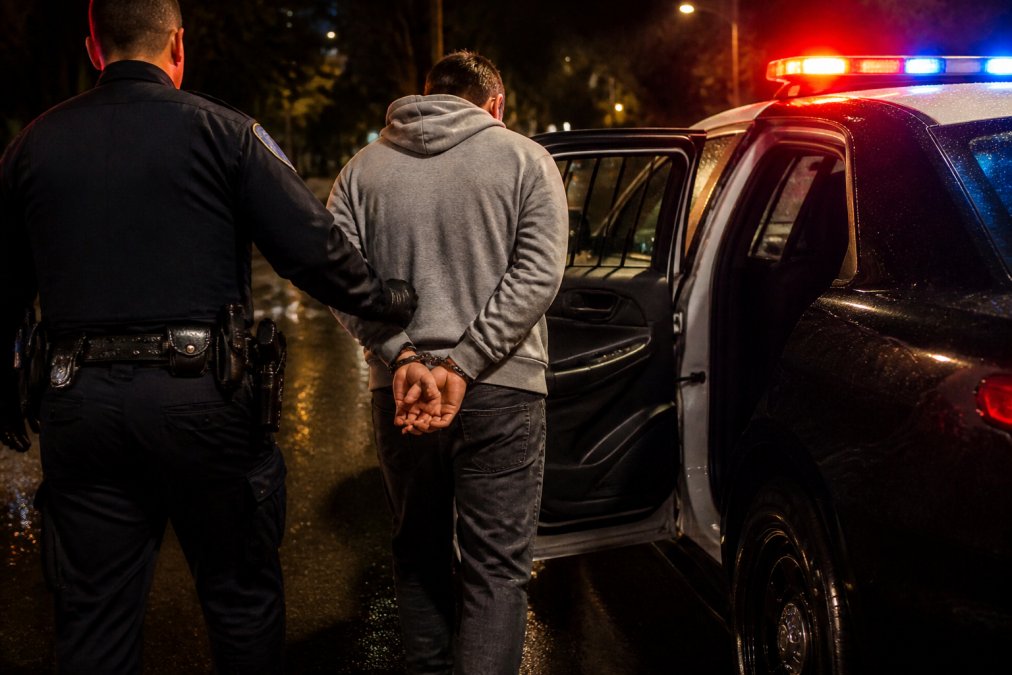
After booking, the case moves to the district attorney for filing. Bail conditions often include a new no-contact order, and the prosecution may request a criminal protective order that outlasts the case itself. The National Institute of Justice's research on protective order outcomes found that for survivors who experienced violations, overall levels of violence and abuse still declined significantly compared with the six months before the order. That gap matters: the order is working even when enforcement is imperfect.
Request a Free Case Evaluation →
Defenses for Restraining Order Violations
Defenses for restraining order violations usually attack one of three elements: the order's validity, the defendant's knowledge, or the willfulness of the act. If the order had expired, was never served, or was too vague to follow, the charge weakens. Consent is not a defense to a criminal order, but mistaken identity and accidental contact sometimes are.
- No valid order in effect at the time
- No proof of service or notice
- Contact was unintentional or unavoidable
- Insufficient evidence tying the defendant to the act
A common mistake, and one that shows what happens if you violate a domestic violence restraining order, is talking to the protected party about the case. Any message, even an apology, can become a fresh violation and new digital evidence.
Interstate Enforcement and Impact on Child Custody
Protective orders carry across state lines under the Full Faith and Credit Clause of the U.S. Constitution and the federal Violence Against Women Act. In plain terms, a valid protective order issued in one state must be enforced by every other state, and a violation can be prosecuted in the state where the conduct occurred, even if the order was issued somewhere else. That catches out-of-state respondents off guard, and it is one of the angles most guides skip.
How Interstate Enforcement Actually Works
When a protected party moves or travels, the order travels with them. Law enforcement in the new state can verify the order through the National Crime Information Center (NCIC) protection order file, which is maintained by the FBI. Officers who respond to a call can confirm the order's existence and terms in the field, then make an arrest under the new state's enforcement statute. The order does not need to be registered in the new state first, though registration can make enforcement faster and is often recommended for long-term moves.
A violation in the new state can be charged under that state's law, and the original order remains active in the issuing state. That means a respondent can face charges in two jurisdictions for the same course of conduct if the conduct crosses state lines, such as repeated calls from one state to a protected party in another.
Child Custody and Visitation Consequences
A violation can trigger a modification hearing in the family court case that issued the order, or in a separate custody case. Courts treat a violation as evidence that the respondent poses an ongoing risk, and that finding can restrict visitation, require supervised visitation, or shift primary custody to the protected party. In some cases, the court orders a custody evaluation or a batterer intervention program before any unsupervised contact is restored.
Survivors with more severe histories of violence and reported stalking face a higher risk of order violations, per research in the Journal of the American Academy of Psychiatry and the Law. Courts read that risk into custody decisions, and a documented violation becomes a permanent part of the family court record. Even after the criminal case resolves, the violation can be cited in future custody disputes, relocation requests, and requests to modify visitation.
Renewal and Long-Term Effect
A violation can also affect whether the order is renewed. In one appellate matter, the Family Violence Appellate Project successfully challenged a trial court's refusal to renew a survivor's restraining order, and the Court of Appeal granted the renewal. The takeaway is that violations are not isolated events; they become evidence in the next proceeding, whether that is a renewal hearing, a custody modification, or a new criminal case.
For a respondent, the practical consequence is that a single violation can follow them across state lines and into family court for years. For a protected party, the practical consequence is that documenting each violation, preserving digital evidence, and reporting promptly builds the record that courts rely on when making custody and renewal decisions.
Frequently Asked Questions
Can you be arrested immediately for violating a restraining order?
Yes. Law enforcement can arrest you on the spot if they have probable cause to believe you violated a domestic violence restraining order. Under California law, officers may make a warrantless arrest for a violation, including for acts that occurred outside their presence. Once arrested, you face booking, potential bail conditions, and formal charges filed by the district attorney. A restraining order violation is treated seriously, and an arrest can happen even for a single text message or indirect contact through a third party.
Is violating a restraining order a misdemeanor or a felony in California?
A first violation of Penal Code 273.6 is typically a misdemeanor, carrying up to one year in county jail and a maximum $1,000 fine. However, if the violation involved violence or a threat, or if you have a prior violation conviction, the charge can be elevated to a felony. Felony violations carry harsher penalties, including state prison time. Violations involving stalking or harassment can also trigger escalation. The specific facts of your case determine the level of the charge.
What are the potential jail time penalties for violating Penal Code 273.6?
For a first misdemeanor violation of Penal Code 273.6, the maximum is up to one year in county jail and a fine of up to $1,000. If the violation involved violence, the fine can reach $2,000. A second or subsequent violation can be charged as a felony, which carries a potential state prison sentence. Probation violations can also lead to additional jail time. A judge may impose probation instead of jail, but any violation of probation terms can result in immediate incarceration.
How does a violation affect future criminal proceedings?
A restraining order violation can impact future legal proceedings in several ways. It may be used as evidence of a pattern of behavior, influence custody and visitation decisions, and lead to enhanced penalties if you face new charges. A conviction creates a criminal record that can affect employment, housing, and gun rights. If you are already on probation or parole, a violation can trigger a revocation hearing. An attorney can challenge the evidence and work to minimize these consequences.